
Nineteen articles, one argument: most organisations are built to record the past, not navigate the future — and that single design flaw is why good strategies still fail in execution.
Written for the CEOs, CFOs and CIOs who own the outcome and suspect their reporting isn't telling them the whole truth.
Start Here
Five questions that reveal whether your organisation can see forward at all — or whether everything you know about your portfolio already happened. The diagnostic the rest of the series builds on.
Read →
Across every industry, the same failure repeats in different clothes. The case that drift, watermelons and governance theatre aren't separate problems — they're one design flaw: accountability without navigation.
Read →
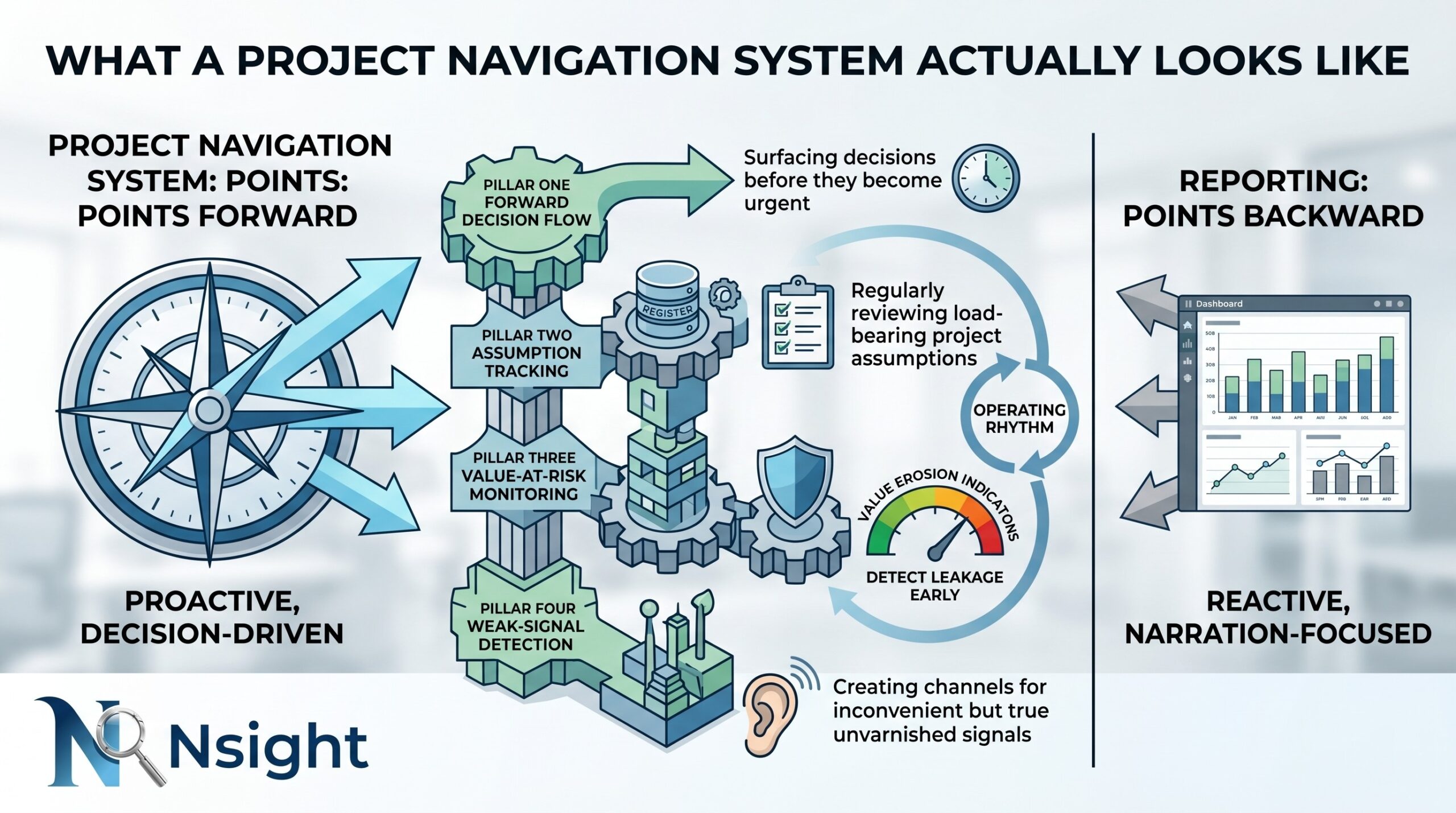
The four things a reporting system structurally cannot do — forward decision flow, assumption tracking, value-at-risk, weak-signal detection — and how to start building them.
Read →
If you read only one
A project is defunded by accident and for three months nothing breaks. The question that follows exposes the watermelon that passes every alignment audit: green, dutifully linked, serving an objective that no longer matters.
Read →Nobody noticed for a quarter
The watermelon in its most dangerous form: accurately green, properly aligned, serving an objective that stopped mattering.
Are you flying blind?
A five-minute test of whether your reporting shows you the truth or a comfortable fiction.
Every transformation problem Is the same problem
The keystone: eight familiar failures traced to one root — built to account for the past, not navigate the future.
Why projects drift
Projects don't fail in a moment; they drift quietly while everyone watches the wrong signals. Six predictable causes, and what holds the line.
What a navigation system actually looks like
The four pillars of a portfolio you can steer, and where to start.
The executive's role in transformation has been misunderstood
Why success quietly shifted from "delivered the plan" to "protecting value in motion" — and what that now asks of the person at the top.
Your PMO is a historian. That's not what you need.
The function best placed to protect your future has been optimised entirely for your past. Reframing the PMO from reporting to foresight.
The sponsor paradox
Why brilliant sponsors get trapped by a system that only shows them the iceberg once it's scraping the hull. The Warning / Intervention / Collision fault line.
The sponsor's playbook: from oversight to active stewardship
How the best sponsors work the gaps between meetings — looking through the windshield, not the rear-view mirror.
The governance reset
Five non-negotiable functions that turn governance from passive reporting back into active value protection.
The five functions of governance that actually create value
Governance as a system, not a committee: prioritisation, decision velocity, predictive assurance, benefits as a discipline, operating rhythm.
Governance theatre: when governance exists but doesn't govern
The rituals of oversight without the substance of control. Committees meet, risks are noted, nothing is decided — and the program drifts.
The three decisions that quietly determine whether a transformation succeeds
What you won't do, who owns the value, and how you decide. The upstream choices leaders think they've made but haven't.
The annual budgeting trap
How the fixed yearly budget institutionalises slow decisions and traps capital in last year's priorities. A hybrid funding model as the fix.
Strategic pruning: The "Saying No" framework
Most portfolios are suffocating under good ideas. Why disciplined subtraction beats adding initiatives — including how to kill the 60%-done zombie.
Cultural debt: the invisible portfolio killer
The compounding cost of every difficult conversation avoided and every truth softened. It accrues silently and is called in at the worst moment.
The hidden cost of slow, soft, or silent decisions
Three ways decisions quietly destroy value, and the five-part chain that turns them from bottlenecks into accelerators.
The value realisation gap
Why organisations deliver outputs but not outcomes — and why the gap is created upstream, by the leadership system, not the delivery team.
The whole series comes back to one question: are you navigating, or just recording? The fastest way to answer it for your own portfolio is to take the test.
Take the 5-minute Flying Blind test Work with me