
I've spent fifteen years inside the portfolios of major Australian organisations — ANZ, Australia Post, AGL, Asahi — and the same pattern repeats everywhere. The reporting is thorough. The governance is heavy. The post-mortems are excellent. And yet the problems still arrive as surprises. Nsight exists because I became convinced that's not a discipline problem. It's a design problem. Most organisations are built to account for the past, not to navigate the future — and you can't steer with a rear-view mirror, however polished it is.
Think of two roles. The Historian records what happened — accurately, diligently, after the fact.
The Navigator works out where you are now, where you're heading, and what to change while there's still time to change it.
Almost every organisation I've worked in is staffed with superb Historians and starved of Navigators. Month-end is sacred. Variance analysis is immaculate. But ask "which of our initiatives is quietly going wrong right now, and how would we know?" and the room goes quiet.
My work is about closing that gap — turning portfolios that record the past into portfolios that can navigate the future. Everything Nsight does, from the dashboards to the advisory to the writing, comes back to that one distinction.

I trained as a Chartered Accountant, which sounds like the least interesting fact about me until you understand what it actually teaches you: to never take a number at face value. A CA's instinct is to ask where a figure came from, what assumption it's resting on, and what it's quietly leaving out. A green status report is just a number wearing a colour — and I learned early to ask what it isn't telling me. That instinct is the thread through everything since. I added an Honours degree in Information Systems, which put me on the boundary between the financial and the technical — the two languages that most often fail to translate inside a transformation. I can sit with a CFO and a CIO and hear the same problem described two incompatible ways, and bridge it. Fifteen years across financial services, energy, retail, FMCG, government and consulting taught me the rest: that the patterns repeat across industries, and that the answer to a problem in health has often already been solved, unrecognised, in energy or banking.
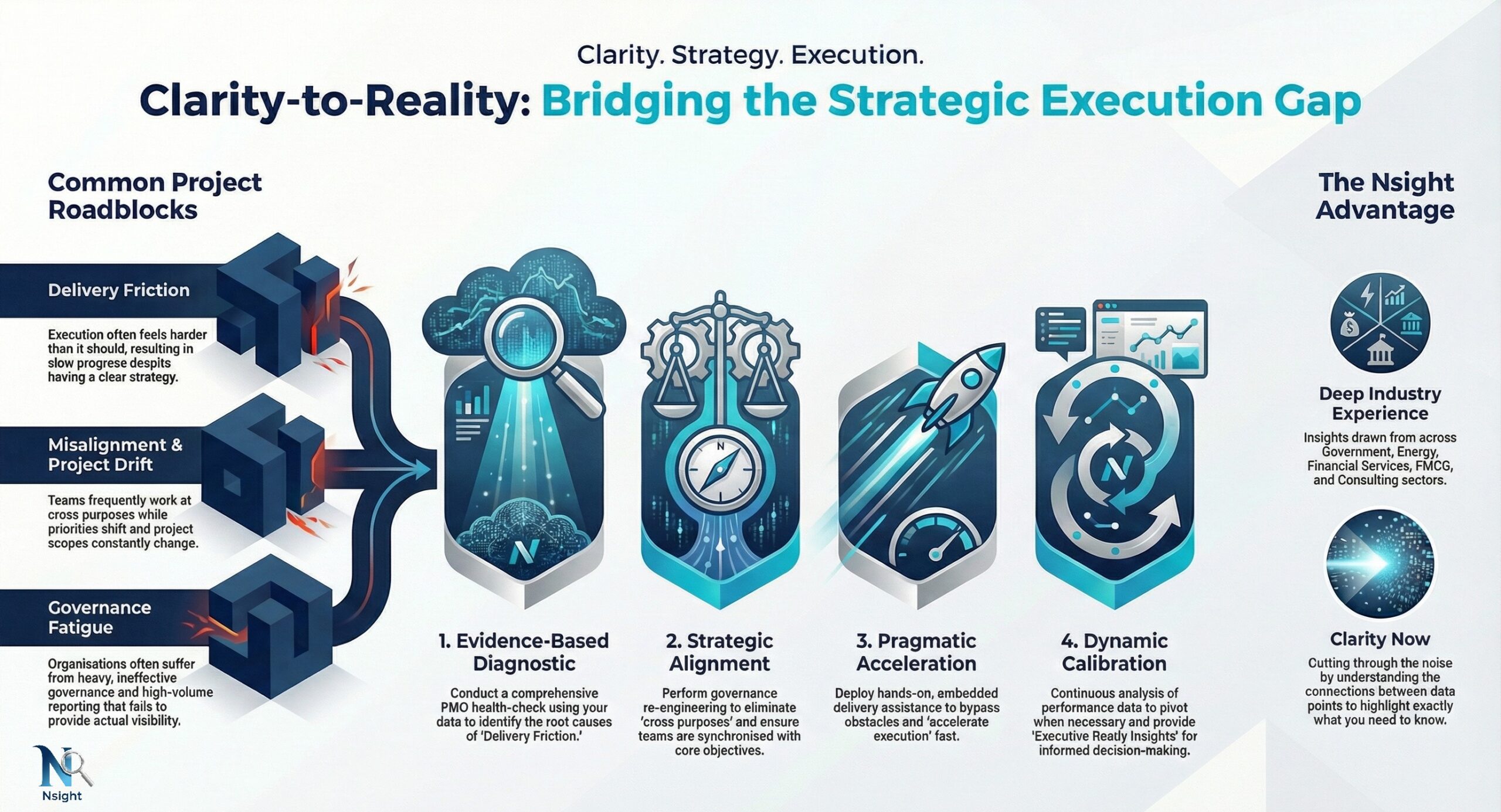
Good advice that doesn't survive contact with your organisation is worthless. My engagements are built to land, not just to look good in a deck. The method is deliberately simple — diagnose what's actually happening, make it visible to the people who can act, and build the capability to keep seeing clearly after I've gone.
The fastest way to find out whether you're navigating or just recording is to test it.